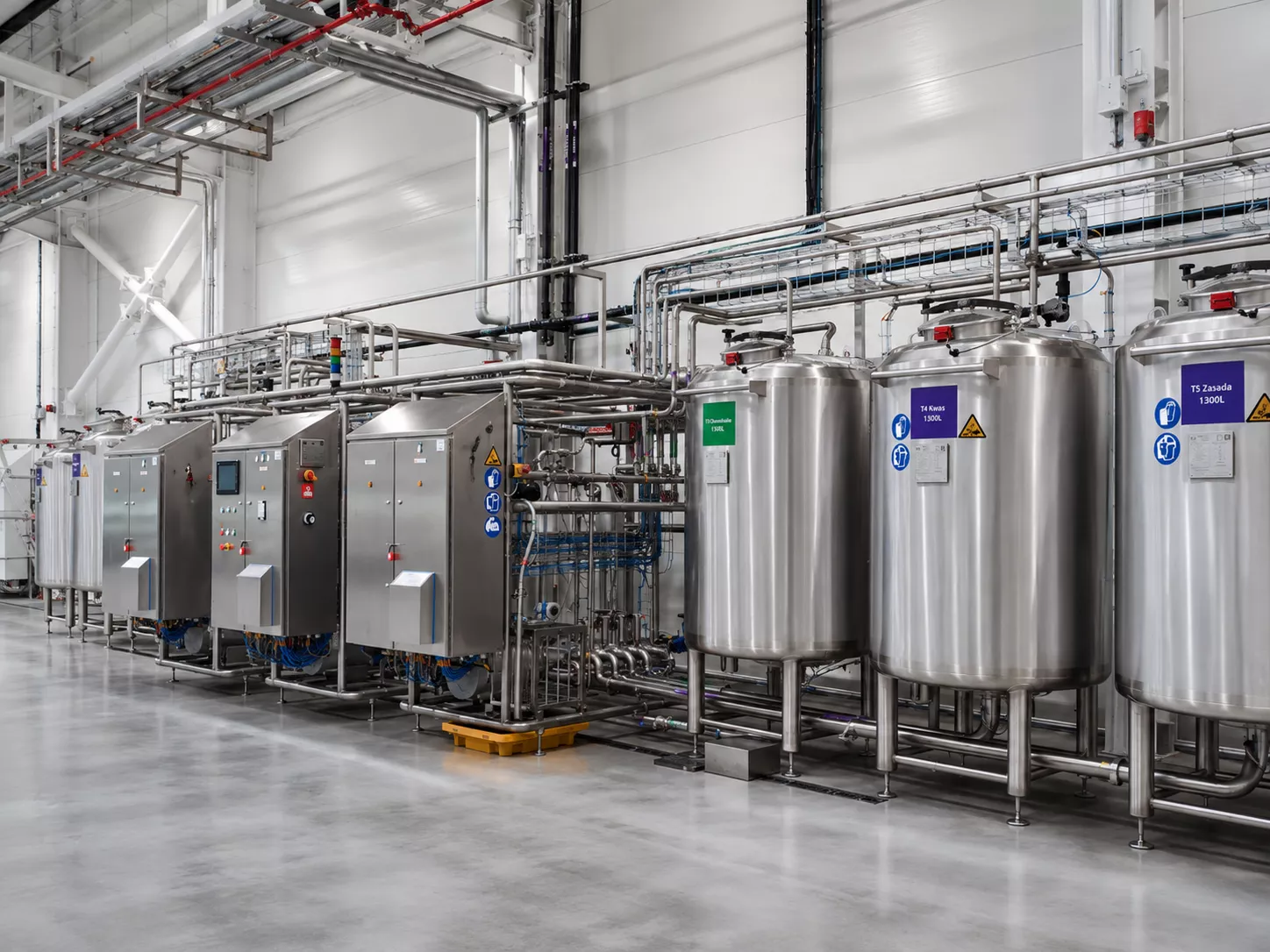
CIP Fundamentals
11 min read time
Oct 15, 2026
On This Page
Clean-in-place (CIP) cleaning removes product residues from processing equipment without routine disassembly. In the food and beverage industry, CIP systems circulate or spray water and cleaning solutions through tanks, pipelines, heat exchangers, and other processing equipment.
The aim is to consistently eliminate product residues and to get the equipment ready for the next production run. Just carrying out a cleaning procedure is not sufficient: it is necessary to achieve the required flow, temperature, chemical concentration, and contact time in the areas where cleaning is needed.
This article explains how CIP works, the main CIP cleaning steps, types of CIP systems, key operating parameters, and applications in food and beverage manufacturing.
CIP is an acronym for Clean-in-Place, and it is also expressed as clean in place or cleaning in place; it cleans the internal surfaces which come into contact with the product by circulating or spraying cleaning liquids through the installed circuit.
They are capable of removing types of dirt including proteins, fats, sugars, and mineral scale. A typical CIP system makes use of tanks, pumps, instrumentation, valves, and a programmable logic controller (PLC) to carry out and record a set procedure.
CIP can be either automated or semi-automated; in both cases the procedure has to be suitable for the equipment and the residues. Cleaning may then be followed by sanitization or, if necessary, by a separate sterilization process.
In CIP cleaning processes, a CIP station supplies rinse water and detergents to a selected circuit. The liquids come into contact with the equipment surfaces before flowing back to a recovery tank or being drained. Changes in conditions can occur during the journey; for instance, the temperature at the outlet of the station might be higher than it is at the end of a long pipeline.
Cleaning requirements should therefore be assessed at relevant points along the circuit, not just at the CIP station. Cleaning circuits, equipment connections, valves, and measurement points can be documented through P&ID development.
A flowmeter or temperature probe confirms conditions at its measurement point, not across all product-contact surfaces. Accurate circuit documentation and proper instrument placement help engineers interpret CIP process data in the context of the equipment being cleaned.
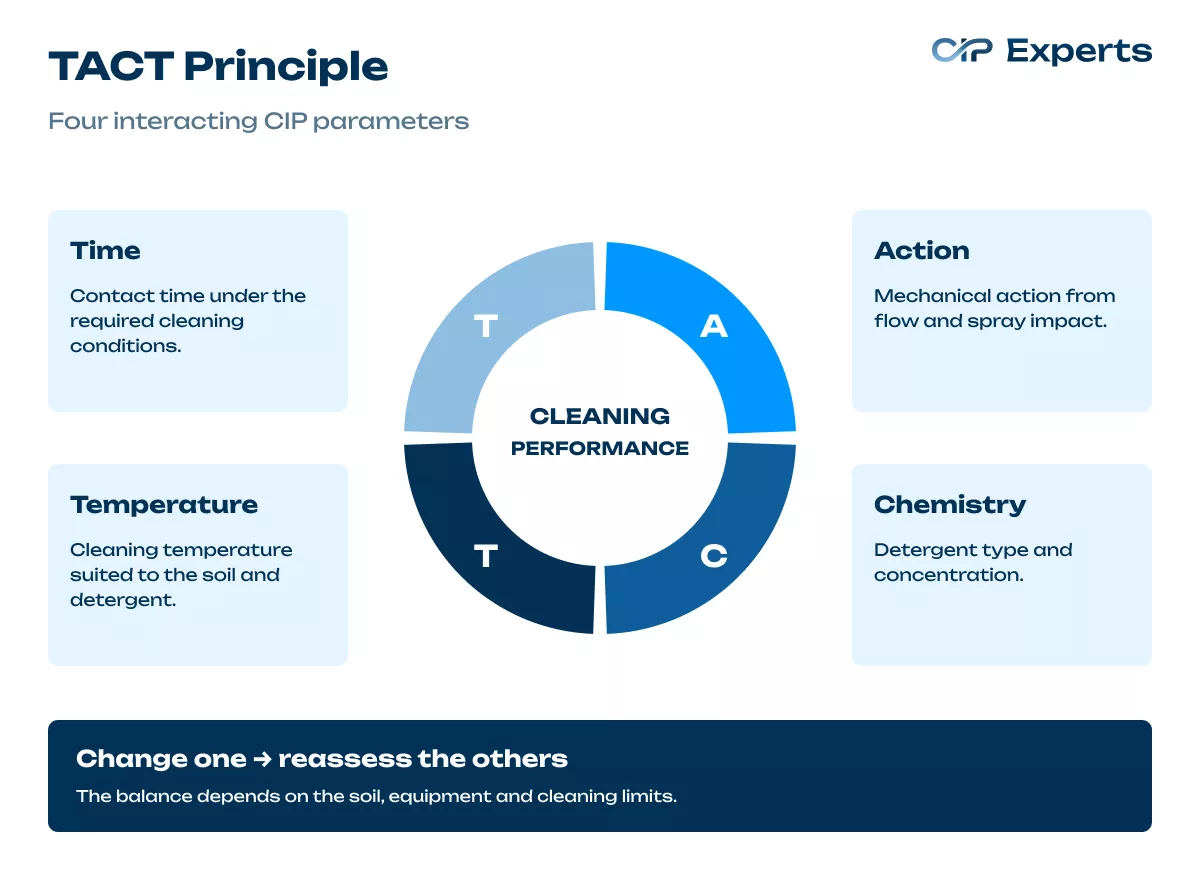
The TACT principle describes four interacting cleaning factors:
Changing one factor may sometimes compensate for another, but only within limits. A longer wash will not fix a spray shadow, and stronger detergent may increase consumption without reaching an inaccessible surface.
For example, a nominal 20-minute wash may offer less effective cleaning time if the circuit needs several minutes to fill, heat, and reach the specified concentration. All four TACT factors need to be considered together.
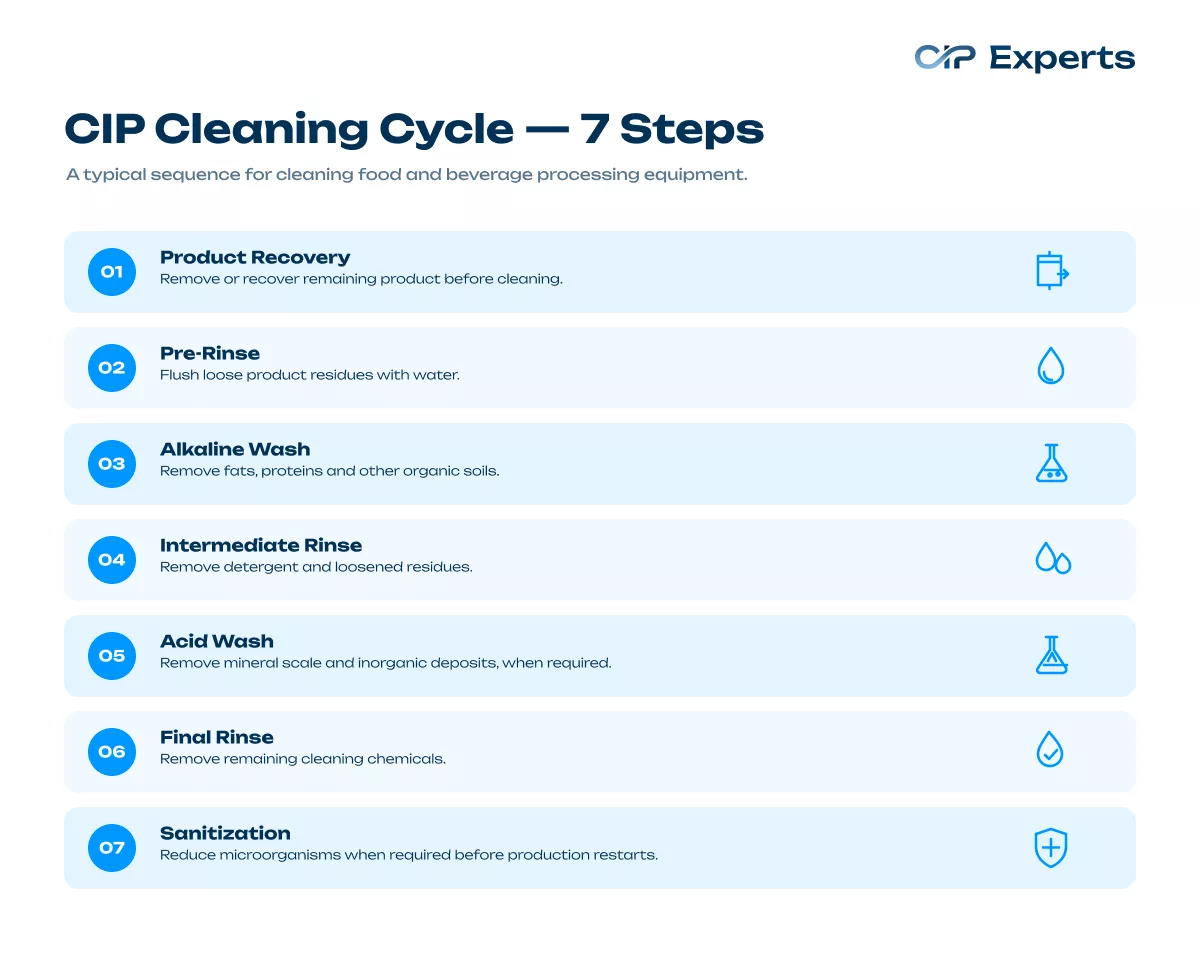
A typical CIP cycle involves the following stages, the order of which will vary according to the equipment, the residues, and the validated cleaning procedure.
Remaining product is drained, displaced, or recovered where practical, reducing losses and the soil load entering cleaning solutions.
Water removes loose residues before detergent cleaning. In dairy processing, excessively hot pre-rinse water may coagulate proteins and make them harder to remove.
An alkaline detergent, often based on sodium hydroxide, removes organic deposits such as fats and proteins. Flow, temperature, concentration, and exposure time must meet specified requirements.
Water removes loosened residues and remaining alkali before another cleaning stage, helping prevent incompatible chemicals from mixing.
An acid detergent removes mineral scale and other inorganic deposits, particularly from heated surfaces such as those in pasteurizers.
Water removes detergent residues. Conductivity, pH, or chemical-residue testing may help determine whether defined rinse criteria have been met.
Chemical or thermal treatment reduces microorganisms to the required level. Sterilization is distinct from cleaning and has separate acceptance criteria.
Not every circuit needs every stage. The sequence and endpoints must match its cleaning requirements. In particular, rinse phases should not necessarily stop at a fixed time: when suitable instrumentation is available, validated conductivity or other endpoint criteria can help determine whether the relevant phase is complete.
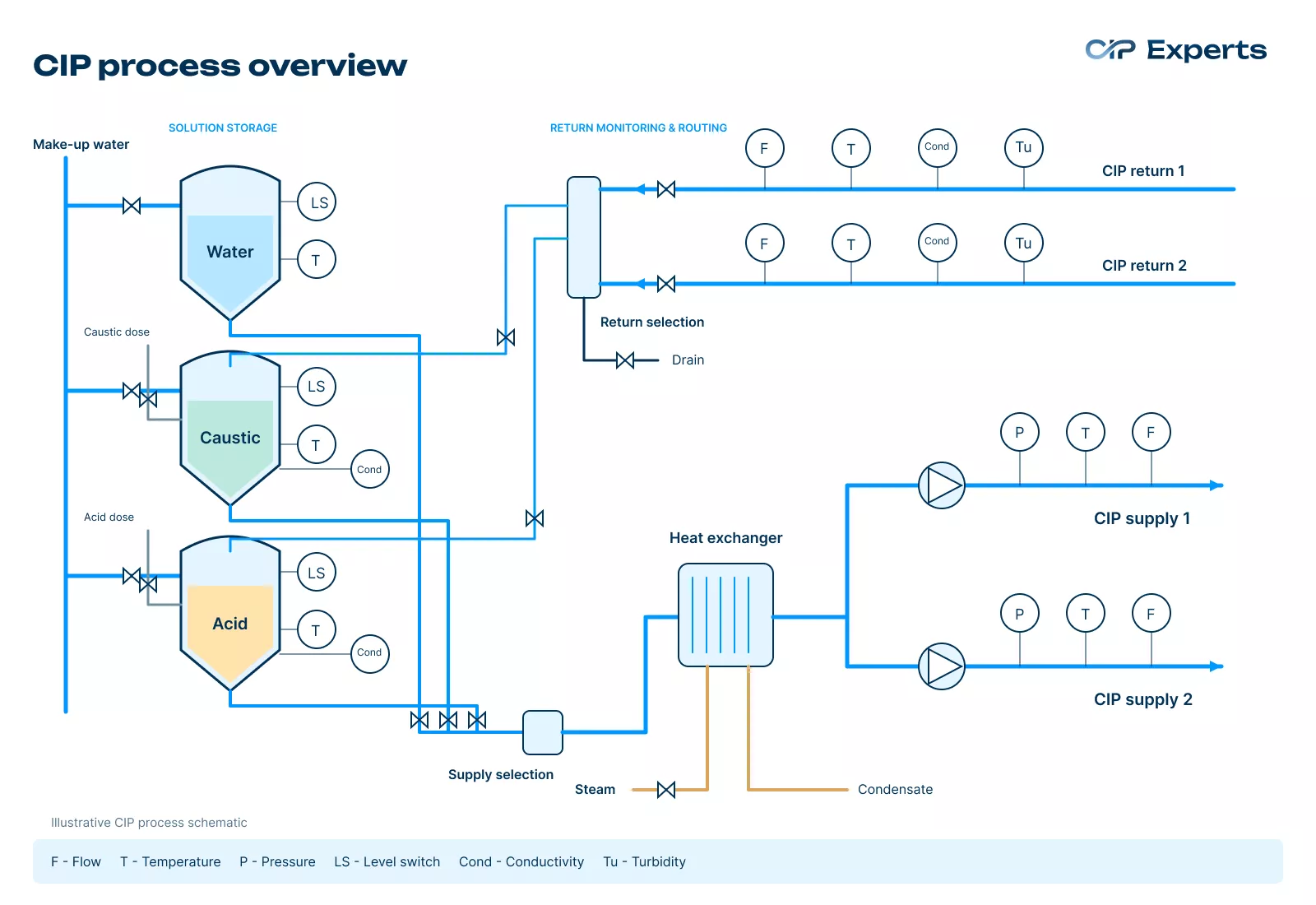
A typical installation includes:
Production equipment must also be designed for cleaning. Poor drainage, unsuitable gaskets, dead legs, or inaccessible surfaces can retain residues even when the CIP program finishes without an alarm.
The CIP systems vary according to how the cleaning solutions are used and the locations of the stations.
Single-use CIP systems are used to prepare cleaning solutions for a cleaning operation and then discharge them afterwards. The term ‘single-use’ describes how the cleaning solution is handled, not the equipment or its components. This method can offer flexibility when dealing with different types of soil contamination, but it may result in higher consumption of water, chemicals, and wastewater.
Reuse or recovery CIP systems collect certain cleaning solutions for later cycles. Recovery can lower resource use, but the reused liquid must still work for cleaning. You need to check its detergent concentration, contamination, and overall condition.
The choice depends on process requirements, circuit separation, operating costs, and the quality controls available. For example, recovery may be less suitable when the recovered liquid carries a high soil load or when different products present incompatible contamination risks. Neither approach replaces cleaning validation, and solution reuse must follow the facility’s defined recovery criteria.
A centralized system supplies multiple circuits from one station, concentrating solution preparation and management.
A decentralized system uses smaller stations closer to production equipment. Shorter transfer distances may reduce line volumes and distribution losses. Either layout can use single-use or recovered solutions.
The choice of cleaning chemicals depends on the type of soil and on the compatibility with the equipment. Detergents which are alkaline, such as those containing sodium hydroxide (caustic soda), are able to remove a number of fats and proteins. Detergents which are acidic, for example those based on nitric acid or phosphoric acid, remove mineral deposits.
Some of the formulations also include surfactants, sequestrants, or enzymes. The cleaning chemistry has to be compatible with stainless steel, elastomers, seals, and the other materials that are in contact with the liquid. Stronger solutions or higher temperatures are not automatically superior since inappropriate settings might damage the components, result in a waste of utilities, or fail to remove the deposits that are hard to deal with.
The values below are illustrative examples from certain dairy-processing applications, not universal CIP settings.
Table 1. Typical CIP Operating Parameters
| Parameter | Illustrative range |
| Alkaline solution concentration | 0.5–2.0% sodium hydroxide by weight |
| Alkaline cleaning temperature | Around 70–80°C |
| Acid solution concentration | 0.5–1.5% nitric acid by weight |
| Acid cleaning temperature | Around 60–75°C |
| Pipeline cleaning velocity | Approximately 1.5–3.0 m/s |
| Contact time | Defined for the circuit and validated procedure |
The specific settings depend on the residues, the detergent formulation, the materials used, and the hydraulics of the circuit. The fact that a sufficient velocity is achieved in a pipe does not guarantee that spray coverage will occur in a vessel since both static and dynamic spray devices have their own requirements regarding pressure, flow, and installation.
Concentration monitoring based on conductivity also necessitates interpretation that is specific to the detergent and compensation for temperature. The acceptance range should therefore be set up for the detergent being used rather than being taken from another cleaning procedure.
The amount of time that is programmed doesn’t always correspond to the actual effective contact time; for example, if a 20-minute stage takes five minutes to reach the required conditions, it might only give 15 minutes of effective exposure, provided that the conditions stay within the specified range.
Table 2. CIP, COP, SIP and WIP Comparison
| Method | Full name | Main purpose |
| CIP | Clean-in-Place | Cleans installed equipment without routine disassembly |
| COP | Clean-out-of-Place | Cleans removable equipment components separately |
| SIP | Sterilize-in-Place | Applies a validated sterilization process to installed equipment |
| WIP | Wash-in-Place | Describes in-place washing; meaning varies by supplier |
In dairy processing, CIP cleaning programs must address protein and fat residues as well as mineral fouling in milk lines, storage tanks, pasteurizers, and HTST/UHT equipment. Heated surfaces deserve particular attention.
CIP cleans fermenters, bright beer tanks, and transfer lines. Recipes must address yeast deposits, organic residues, mineral scale, and flavor carry-over.
Sticky, viscous, sugar-rich, or fatty residues can be difficult to remove. Cleaning depends on chemistry, temperature, hydraulic conditions, and drainage.
A well-designed CIP system reduces the need for routine disassembly and manual cleaning while making cleaning cycles more consistent. Defined cleaning recipes improve repeatability, and cycle records help production and quality teams review deviations and plan production changeovers.
In food and beverage manufacturing, consistent cleaning and documented process records also support hygiene control within broader food safety management systems. These include programs based on HACCP principles and requirements under the BRCGS Global Standard Food Safety and SQF Food Safety Code. In the United States, applicable requirements may also include sanitation controls under the FDA’s FSMA Preventive Controls for Human Food.
For CIP installations, EHEDG Guideline 50 provides guidance on hygienic design, while EHEDG Guideline 45 addresses cleaning validation, monitoring, and verification. These guidelines help manufacturers establish appropriate cleaning practices, although operating a CIP system alone does not demonstrate compliance with applicable food safety requirements.
Beyond hygiene, CIP can also make cleaning-related downtime more predictable and create opportunities to reduce resource consumption. Improved rinse control and cleaning-solution recovery may lower water, chemical, and energy use.
These benefits should be evaluated using plant data, including cycle duration, resource consumption, recorded deviations, and cleaning-test results. A shorter or less resource-intensive cycle represents an improvement only when it continues to achieve the required cleaning outcome.
CIP requires investment in pumps, tanks, controls, instrumentation, and maintenance. Automation cannot make an inaccessible surface cleanable. Worn spray devices, drifting sensors, incorrect valve sequences, or unsuitable recipes can compromise performance.
Clean-in-Place is widely used in food and beverage manufacturing to clean processing equipment without routine disassembly. A typical CIP process combines controlled cleaning steps, chemical solutions, temperature, flow, and contact time to remove product residues.
Understanding how these elements work together helps manufacturers select appropriate cleaning procedures for their equipment and production requirements.
At CIP Experts, we work with food and beverage manufacturers to address CIP challenges through engineering, technical inspections, CIP validation, and process optimization.
Have a CIP challenge worth investigating? Bring us your case.
Thank you for your request!
Our team will contact you soon to discuss your project and the next steps.
Request Sent
Thank you for contacting CIP Experts. Our manager will contact you within one business day.
